Viviana Mendiola

Impermanence and the Discomfort of Change

Mendiola, Viviana. (2026). Impermanence and the discomfort of change. YouTube. CC-BY-SA-4.0.

This video explores impermanence and the discomfort it brings. The imagery shifts between different stages of my life, and it features a historical photograph, urban scenes, travel images, transitions between living and work spaces, and ocean views. The structure is intentionally uneven. It reflects movement rather than stability.

The images in this project are intentionally ordinary—snapshots taken in moments of transition. Their slight imperfections mirror the theme itself: the unease of movement, the unfinished quality of change.

The ocean appears throughout the video as a quiet constant. I have lived in different places and moved through different roles, but the ocean has remained a visual anchor. I have viewed it from different windows, different cities, different moments in my life. It is both the same and never the same.

In contrast, the other images represent change: new environments, professional transitions, travel, unfamiliar spaces. The discomfort of starting over. The unease of movement. The instability of identity shifting.

Impermanence is often framed romantically, but lived experience is more complicated. Change can be disorienting. It can feel like loss before it feels like growth.

The phrase, “impermanence, the discomfort of impermanence,” names that tension directly. Awareness does not erase difficulty. Understanding that everything changes does not make change easy.

The ocean, however, continues. It remains in motion without resisting that motion. In that sense, it represents continuity beneath instability.

This project reflects on the contrast between the constancy of the ocean in my life and the instability of career shifts, movement, and personal transition. Impermanence does not disappear. It reshapes.

Attributions

Software

Video assembled using the Apple Photos slideshow tool (macOS).
Exported at 1080p resolution using default slideshow export settings.

Images
Original photography by Viviana Mendiola (2026). Microsoft PowerPoint design tools used to add design elements to the original photographs and to text-only slides.
House Boating on the Miami River, Fla. National Photo Company Collection, Library of Congress. Public domain image, Picryl.
Title image AI-generated using ChatGPT: prompt “the discomfort of impermanence featuring ocean background.”

Elevator image AI-generated using ChatGPT: prompt “elevator with all floors lit up.”
“Passing” image generated using Microsoft PowerPoint design tools.

Credits image AI-generated using ChatGPT: prompt “credit sources used.”

Music
Upbeat Calm Corporate 100 BPM (Full)” by LiteSaturation (Pixabay Content License).

Voiceover
Original recording by Viviana Mendiola (2026).
Marginalia Podcast

Marginalia – Opening Episode. The derivative is licensed under Attribution-NonCommercial 4.0 International (CC BY-NC 4.0).

Podcast Description

Marginalia is a literary podcast exploring memory, attention, and everyday experience. Inspired by Marcel Proust’s reflections on involuntary memory, this opening episode considers how quiet moments — a passing thought, the turn of a page — can subtly rearrange the present.

In this first episode, I reflect on the figure of the flâneuse (the feminine form of the French term flâneur), a woman who wanders city streets, observing urban life with an attentive yet independent perspective.

Sound Elements

Incorporates three sound categories:

  • Voice (Narration): Recorded by author.
  • Music: Introduction and Tarantelle (Op. 43) layered beneath narration.
  • Sound Effect (Original Recording): A live page-turn sound performed and recorded by the author while the music was playing, used as a transition immediately before the narration begins.

The page-turn signals entry into the reflective space of the episode.

Narration and Page Turn

Marginalia – Opening Narration and Page Turn
Author: Viviana Mendiola. License: Attribution-NonCommercial 4.0 International (CC BY-NC 4.0).

Music

Introduction and Tarantelle (Op. 43)
Written by Pablo de Sarasate (1844–1908)
Performed by Mischa Violin and Josef Adler
Recording date: Orange, N.J., 1921
Track URL: https://www.openmusicarchive.org/audio/Intro_And_Tarantelle.mp3
License: Public Domain

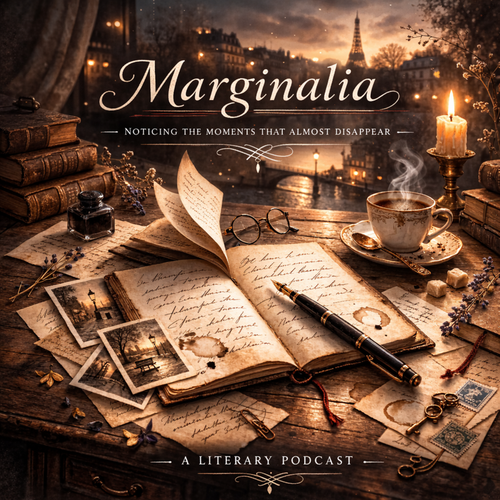
Podcast Cover Image – Marginalia
Image generated using ChatGPT (OpenAI image generation tool).
Prompt and final composition directed by author. Prompt used for image generation: “Vintage literary podcast cover titled ‘Marginalia’ featuring antique books, journal, warm amber lighting, Parisian atmosphere, nostalgic tone.”
Tool: ChatGPT . February 2026.

Rule of Thirds Saves the Birthday Girl

Original
Derivative

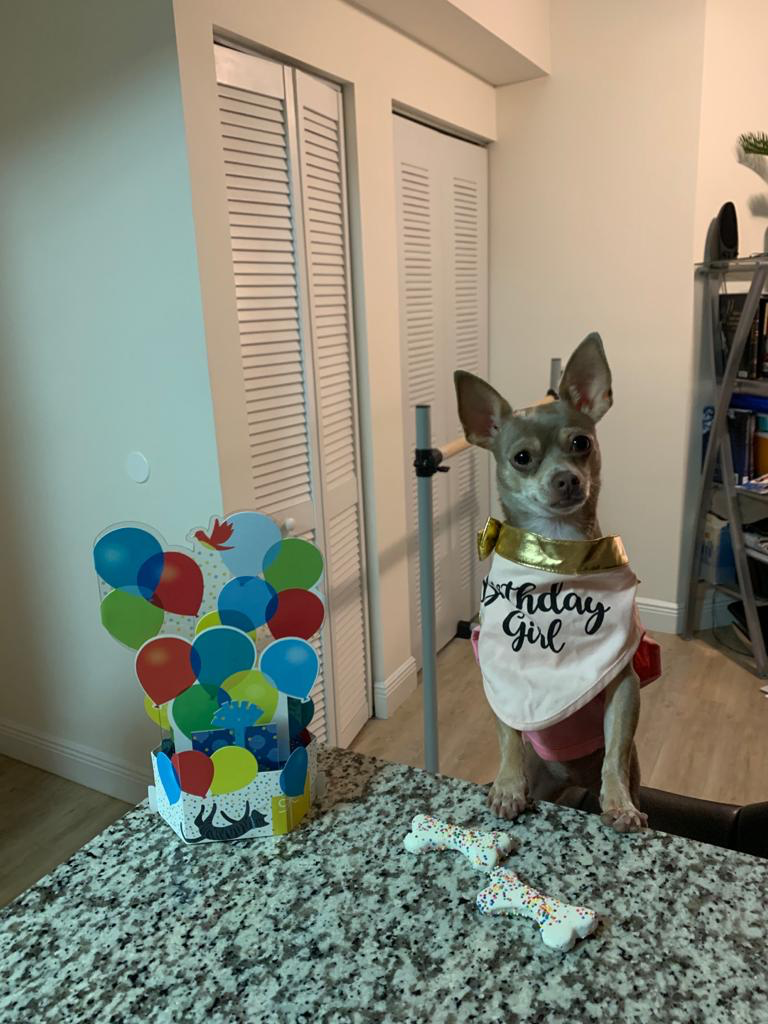
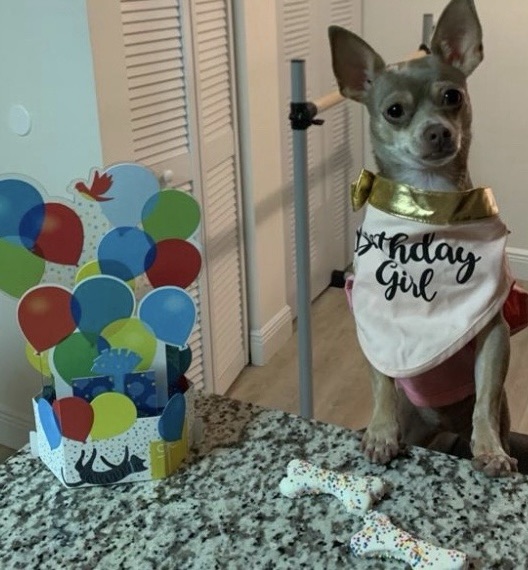
For this assignment, I created a derivative image by cropping an original photo that I took of my dog. The original image included extra background space and distracting elements that competed with her. In the cropped version, I used the Rule of Thirds by positioning her on the right third of the frame and keeping the birthday gift bag on the left third, creating a more balanced composition. The tighter crop also simplifies the background and strengthens the focal point, drawing attention to her expression and the birthday girl theme.

Original image: Birthday Girl (Original) by Viviana Mendiola, original photo (personal photo).

Derivative image: Birthday Girl Spotlight (Derivative) by Viviana Mendiola, licensed under CC BY-NC 4.0.

Resource: Cropping Photos Guide

Ziegler’s Fountain


I chose the image below because of its title, Baden-Baden, which suggested something beautiful and European. Visually, the photograph feels elegant but somewhat dry. Pairing it with the Andalūzijas romance song adds warmth. The title of the photo also made me think of Better Call Saul, where Baden-Baden is referenced by Werner Ziegler as a place of respite. I then recalled how Vince Gilligan uses music to transform visuals into layered experiences—something this pairing attempts to do by letting sound reshape how the image is felt rather than what it shows.

Baden-Baden 10-2015 img13 Hector Berlioz Park by A.Savin, licensed under Creative Commons Attribution–ShareAlike 4.0 International (CC BY-SA 4.0).

Source: https://commons.wikimedia.org/wiki/File:Baden-Baden_10-2015_img13_Hector_Berlioz_Park.jpg

License: https://creativecommons.org/licenses/by-sa/4.0/

Audio:

Andalūzijas romance (public domain sound recording), from Wikimedia Commons.

Source: https://commons.wikimedia.org/wiki/File:Andal%C5%ABzijas_romance3470.wav

License for this work:

This combined work is licensed under Creative Commons Attribution–ShareAlike 4.0 International (CC BY-SA 4.0).

https://creativecommons.org/licenses/by-sa/4.0

On the record; off the shelf

My name is Viviana Mendiola, and I live in Miami-Dade County, Florida. Living here has influenced how I think about communication and access to information, particularly in environments where people rely heavily on digital tools and informal networks to get things done.

I am a practicing attorney. My path here was not linear. Before law school, I had to choose between studying law or library science, and I chose law first. At the time, librarianship did not seem like the right fit. With more experience and perspective, I have come to see it as something I want to explore now, especially in relation to digital media and information work. In many ways, librarianship now feels orthogonal to my legal training while still drawing on it in productive ways.

My interest in digital media connects closely to my work as a Pro Bono Director at a local nonprofit, where part of my responsibility involved supporting the recruitment of pro bono attorneys. Although a PR firm managed our social media accounts, I worked closely with them by providing photos, developing ideas for posts, promoting events, and offering feedback on content. I also helped draft a newsletter as part of those outreach efforts. That experience required thinking carefully about audience, messaging, and the epistemic implications of how information is framed and circulated in digital spaces. It was a collaborative process that taught me a great deal about how digital communication works in practice.

I have always enjoyed writing and visual art. I grew up around drawing and painting, and my mother is currently pursuing a master’s degree related to art. I took a drawing class myself, and while I do not consider myself an artist, I am interested in developing my creative side more intentionally. That interest has increasingly taken on a curatorial dimension, particularly in how visual and textual materials are selected, organized, and preserved.

I studied intellectual property law in law school, although long enough ago that much of it warrants a careful revisit. I am interested in approaching those issues again from a digital media and information-science perspective, particularly in the liminal space where creativity, technology, and authorship overlap.

I am also interested in how libraries function as stewards of cultural memory. One example I find especially compelling is the handwritten lyrics to a Beatles song held by the British Library, which treats popular music with the same archival seriousness as canonical literature. I visited London once but did not make it to the British Library, largely because I was too tired to get off the double-decker bus. That remains an unresolved issue and a reason to return.

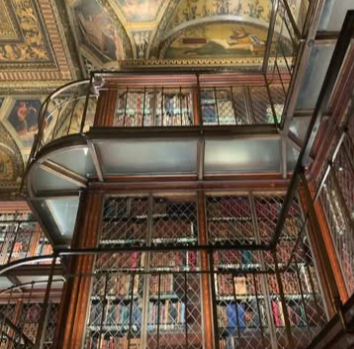
I recently visited The Morgan Library & Museum, and it was a space where architecture, collections, and design reinforced how information can be both rigorous and visually compelling.

I am especially interested in this class because creating a blog is something I have wanted to do for some time. Having it as an assignment provides the structure and push I needed to finally start. I am looking forward to using this space to write, experiment, and think more deliberately about digital media over the course of the semester.

Interior of the Morgan Library in New York

— Viviana