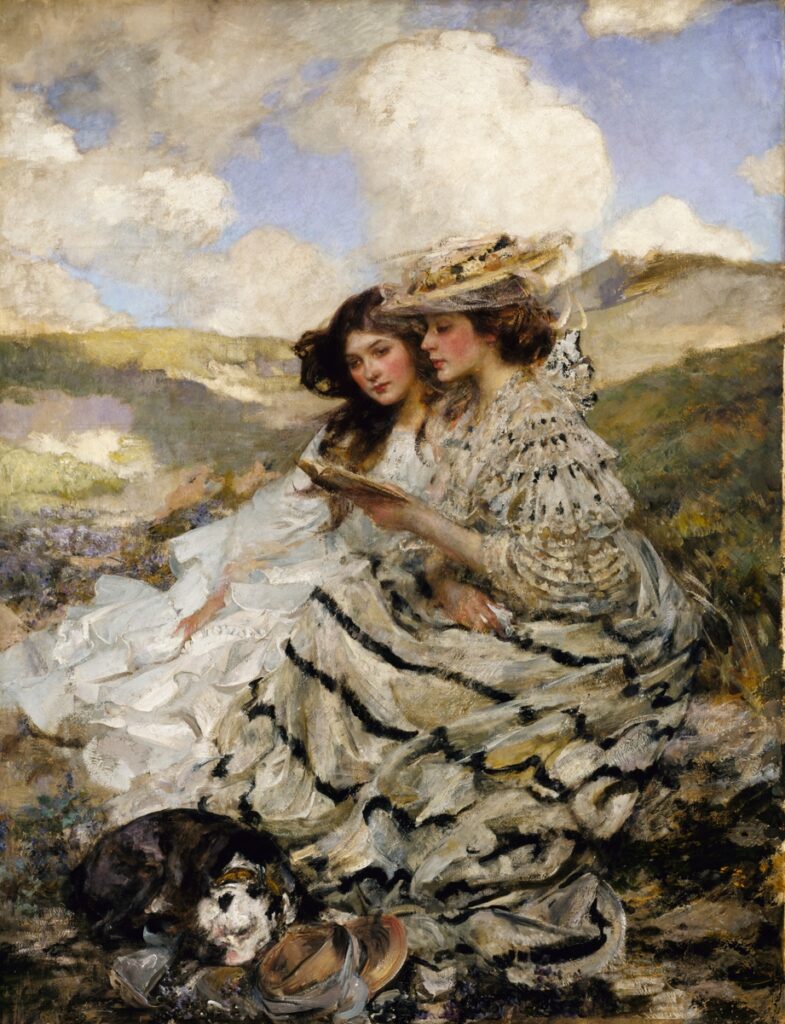
For this assignment, I chose the above image titled On the Dunes (Lady Shannon and Kitty) by James Jebusa Shannon. Shannon painted this portrait of his wife and daughter sometime around 1900 to 1910. I was drawn to this painting because it reminded me of being read to by my own mother. One of our favorites to read together was “Stopping by Woods on a Snowy Evening” by Robert Frost. I chose this audio pairing to evoke the feeling of being read to by a parental figure as illustrated in the painting. The painting becomes an experience when paired with poetry reading; in this particular work I am drawing on my own experiences and memories of childhood.
Terms of Use: On the Dunes, Reading by Emma Preston. Licensed under CC BY 4.0.
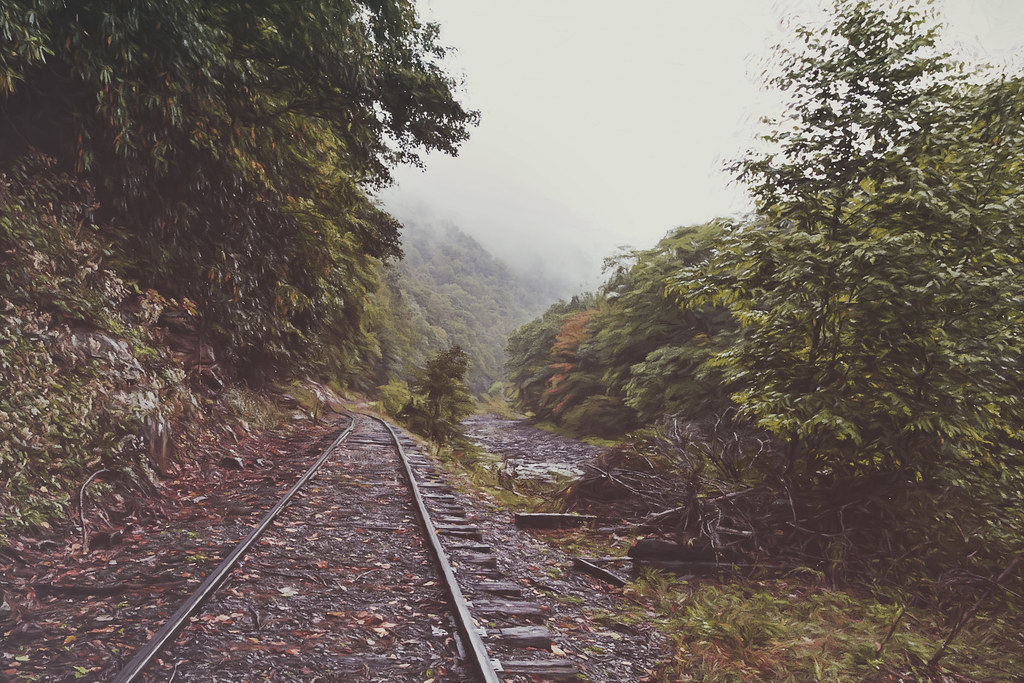
Railroads and trains have always felt nostalgic to me, so I gravitated towards images of them for this assignment. Where I grew up, we had to cross a set of railroad tracks to get onto the highway, so crossing them always felt like a sign of an adventure. Now, I see them most often whenever I have to cross through the seemingly-empty middle of Florida to visit my family on the other coast, which are trips filled with both solitude and nice music. Railroads always reminded me of travel, and now I associate them with my long-distance driving playlist of folk, blues, and indie music. So, I decided to combine the picture of railroad tracks with a blues song by Kevin MacLeod (though the song was trimmed in order for it to be uploaded). Now you can feel like you’re along for the ride with me!
For this derivative work use: “Railroad Blues” by Alyssa Mitchinson is licensed under CC BY 2.0.
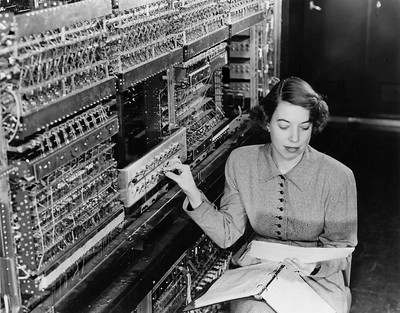
I selected this music because of the title. (My husband has been grinding it out in the Fortune 500 for the last 25 years and until he got some relief from the “new normal” of hybrid work, he frequently complained about Muzak blaring in the office to provide a screen of privacy for conversations.) I like the idea that this woman is taking that common office practice to the next level. It is her job motivate underperforming workers by pumping this inspiring music directly into their cubicles until they meet their production quotas. Middle management has helpfully provided a list of which employees require her assistance to overcome their flagging enthusiasm for their assigned tasks.
I think that the meaning of the picture has changed by this combination and my interpretation. The image of this woman was captured at a time of great optimism that “computers were going to improve our lives” and now that hyped narrative seems a little dubious to many of us. I might be projecting here but Jason Shaw’s title of “Corporate Motivation” for a piece tagged as “bouncy, bright, and uplifting” really speaks to the ambiguity I feel about the benefits and drawbacks of the technological progression of our culture. Benefits for whom? If is is such an improvement for humanity, why do we require such interventions to boost our motivation?
“Provocation Incorporated” by Lisa MacKay-Ring derivative licensed under CC BY-NC-SA 2.0
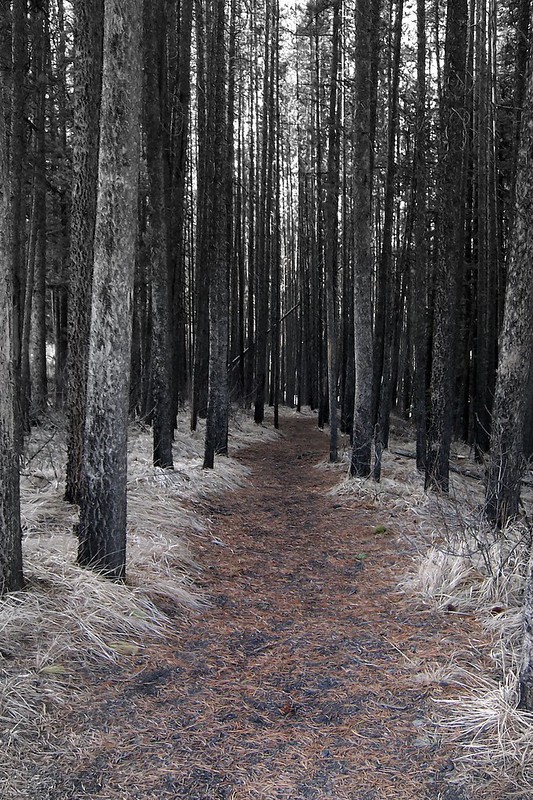
This image drew me in as it is a walk I think I need to be on today. The sound and the image together are reflecting how I am feeling given the state of my world currently and maybe the world as a whole currently. I understand that this will pass but right now everything feels pretty somber and desolate like this winter forest path.
While searching for images, I came across this picture of the Lady Luck building taken in Vegas, circa 2007 by Dan4th. The song, created by Francisco Pinto, is titled Tele-Viaje-Interior, which pretty roughly translates to remote inner journey. That building there doesn’t look like that anymore. In fact, the whole block has changed since then, but here it looks not just stuck in time but in space. Not here space, but slightly-over-there space, just out of your reach. The dusky sky makes it look like it spontaneously re-appeared on Mars, with its structure intact and framed by the planet’s blue-gray sunsets. There’s no valet, and the tarped fence leading into the entrance gives you the feeling that it’s the last stop (only stop?) on our far out rock. As you’re treading the moving walkway toward the doorway, this is the music that starts pumping through your spacesuit. Everything looks the same on the inside, but you weren’t there in Nevada, and the picture only shows what it shows, so what can you know? Back here now, it’s called the Downtown Grand Hotel. You can look it up.
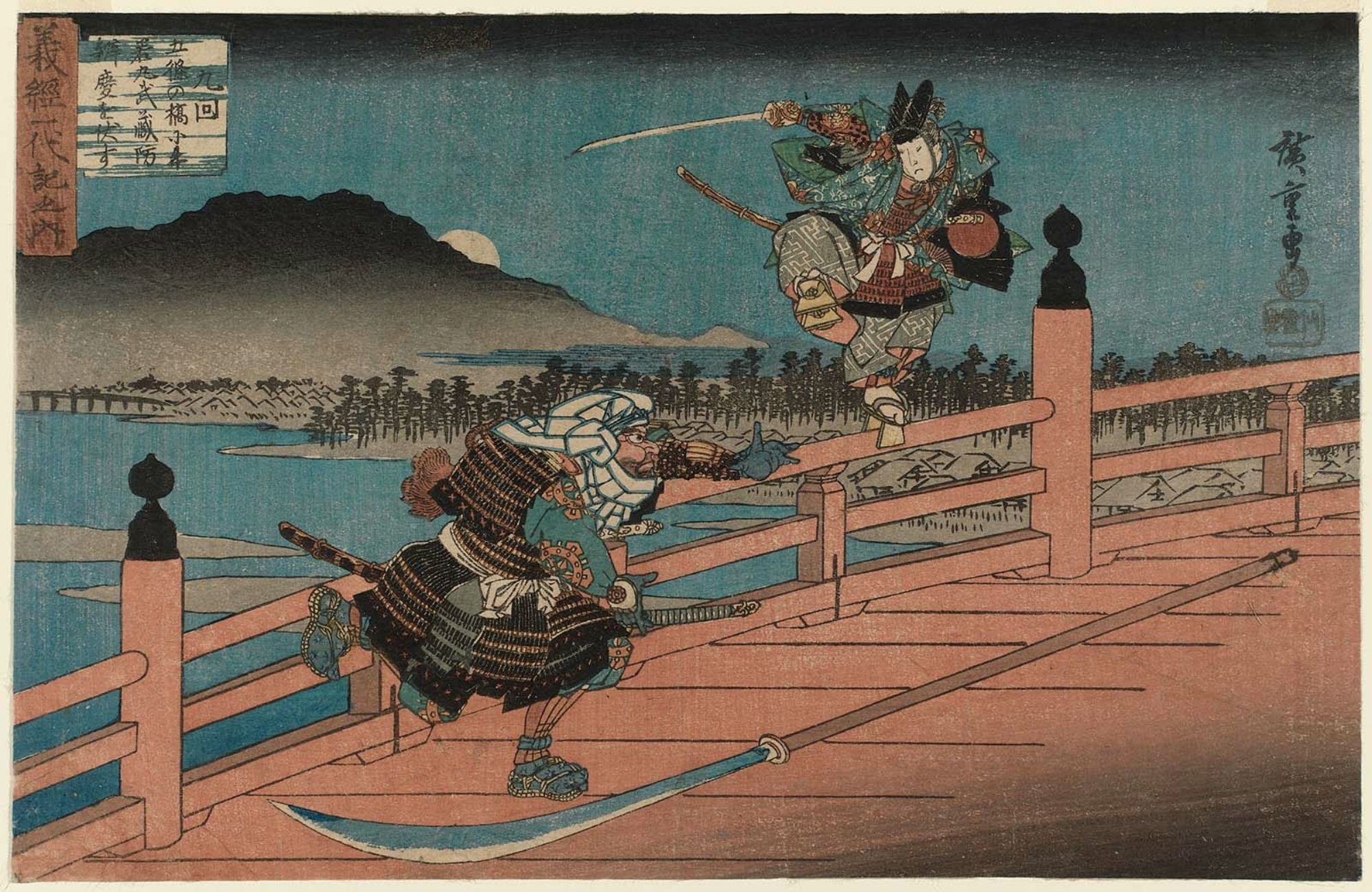
Earlier this week, I was watching a TikTok video of a line of individuals at a Japanese Jiin, attempting to lift a giant spear of steel weighing over 210 pounds. This supposedly was the spear of Benkei, a folk hero of Japan, known for his inhuman strength. In the image above, he is seen reaching for it, to parry another famed warrior, Minamoto no Yoshitsune. I couldn’t help but to get into the rabbit hole of these characters of history – they reminded me of the heroes I read of in comic books or watch in an anime. Now, to find out Benkai passed at the same age as me after slaying 300 soldiers, dying while standing after struck by a volley of arrows…. On one hand, I do not want to go down like that; but on the other, what a way to live – to choose the way you die, to instill fear after your last breath is drawn. These are stories that are retold; music is played in homage to them nearly a millennium later… It’s inspiring.
I promised myself, as a reward for completing this program, I would like to study a martial arts and focus on improving my physical balance, strength, and form. This image and these stories will act as further information, until I too can wield a spear twice my height across a bridge to the drums of history!
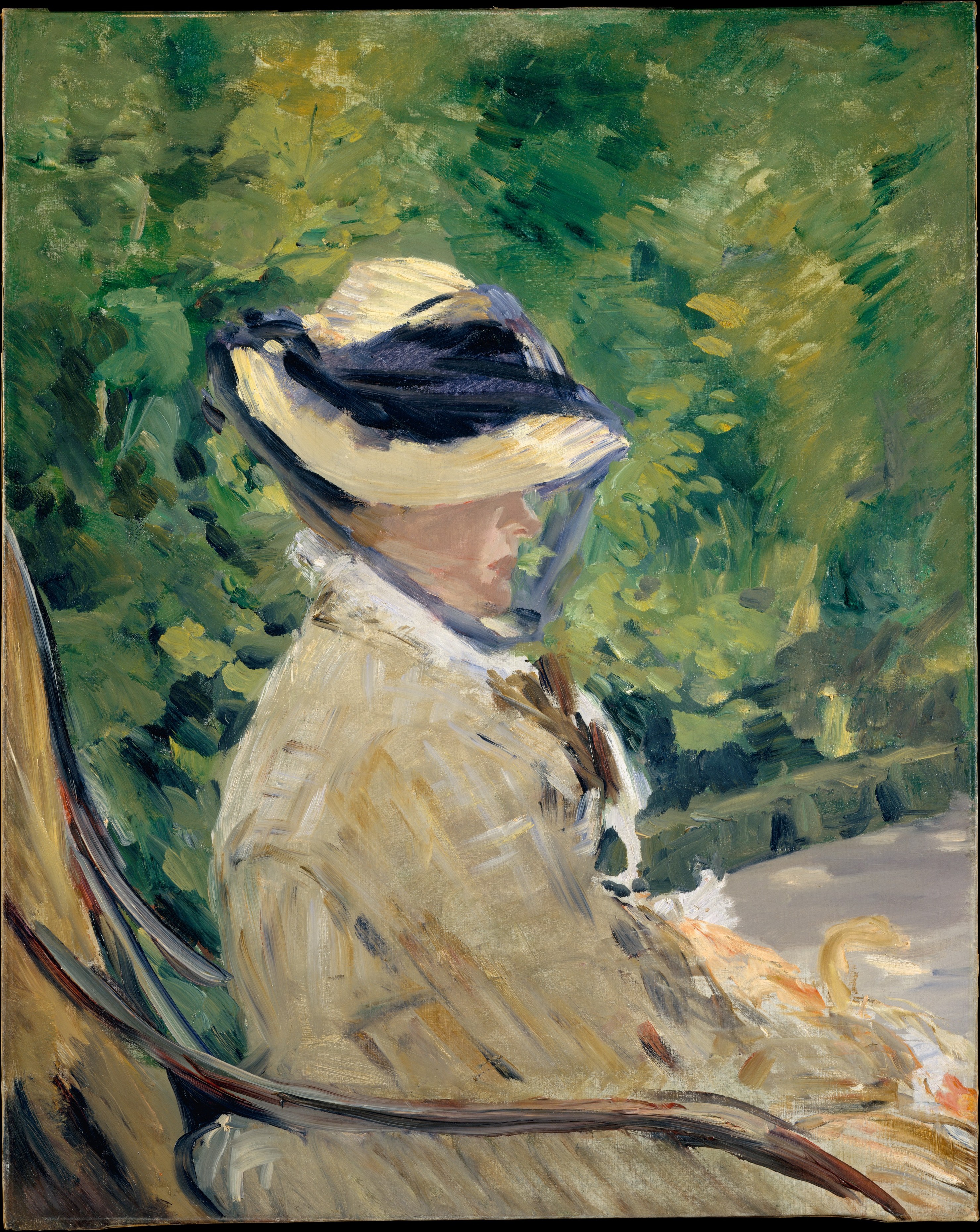
As an art history enthusiast, one cannot help but approach a painting with a heightened sense of curiosity. Who is the sitter, and how does her relationship to the artist shape the image before us? In this painting, the sitter is Suzanne Leenhoff, Édouard Manet’s wife. She sits outdoors, enveloped in lush greenery, her soft yellow dress gently contrasting with the surrounding green. A matching hat dips low, obscuring her eyes and leaving only her nose, mouth, and a hint of hair visible to the viewer. The loose, swift brushstrokes suggest a fleeting, intentional moment, something caught rather than staged. With her gaze hidden, her expression remains a mystery, inviting subtle contemplation from the viewer. Perhaps this is a tender, wistful moment: a husband pausing to capture his wife, suspended in thought, as she looks toward something unseen in the distance.
I chose the audio April Kisses because it echoes the possibility that this painting captures a tender moment of a husband quietly observing his wife. Yet it is difficult to impose a definitive narrative when the artist offers no explicit explanation for the work. As art historians, we often begin with visual analysis, a surface-level reading that allows us to form an initial interpretation before turning to historical context and primary or secondary sources for support. Questions about Manet’s relationship with his wife inevitably arise, but for now, this pairing remains rooted in what the image itself suggests. The scene feels soft and intimate, as though the artist has paused to observe the sitter in a gentle, fleeting moment. For this reason, I selected a piece of music that feels equally sweet and whimsical, reminiscent of a quiet dance shared between two people.
I was drawn to this image because it reminds me of the Finger Lakes region of Upstate New York, where I grew up spending a lot of time hiking and exploring wooded trails. This type of scenery brings me a strong sense of calm and peace, and it reflects the kind of environment I still enjoy returning to when I need to slow down or feel grounded. On its own, the image feels quiet, familiar, and inviting.
For the audio, I intentionally chose a sound that contrasts with that feeling. The assignment encouraged us to avoid obvious pairings, such as calming music or natural forest sounds, so I selected a more unsettling, “creepy” ambient drone. When combined with the image, the meaning shifts. Instead of feeling purely peaceful, the forest path becomes more unclear and slightly uneasy. The audio alters the viewer’s interpretation, suggesting that the trail may hold something unknown or unseen beyond the frame. Together, the image and sound create a new experience, one that challenges the sense of calm I personally associate with this type of landscape and invites the viewer to question what lies ahead.
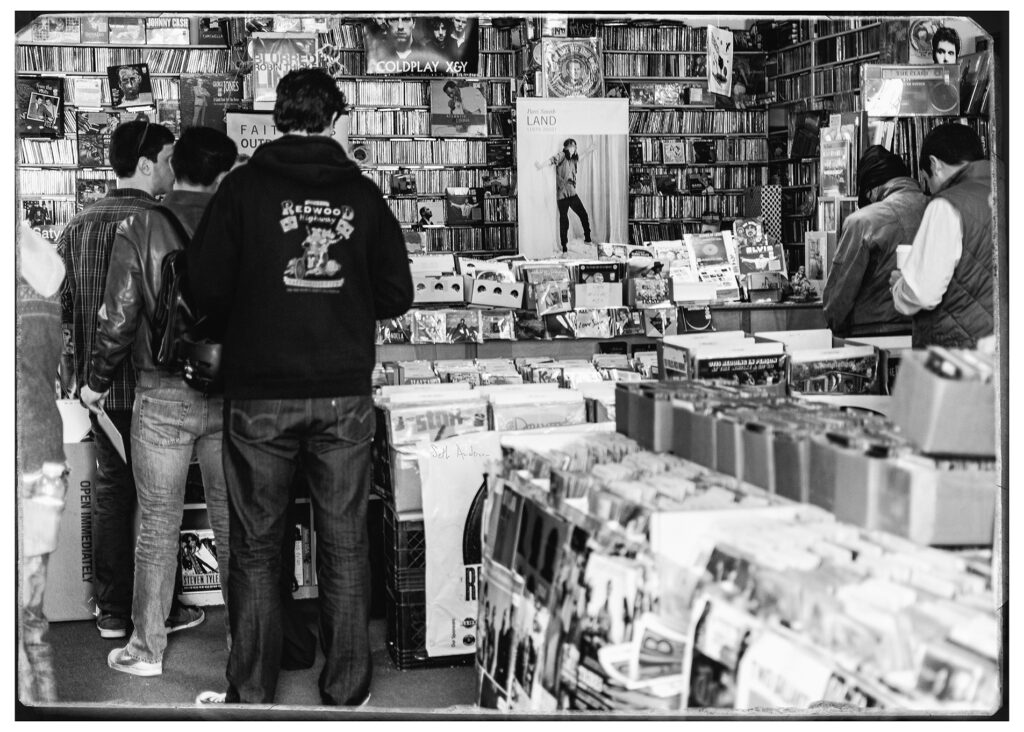
Record stores are one of those places where time travel and instant teleportation are possible. Exploring the global section (my favorite section) and finding music, artists, and songs I’ve never heard of before is just like going on a journey. My mind fills with questions: What is this artist doing now? Are they even still alive? Did they ever think their song would reach someone in the United States fifty years after its release?
While the photo Standing In Line on Record Store Day 2014 (Explored) by Seth Anderson was taken around 10 years ago, the black and white editing made it appear more vintage. Once I looked closer, I could clearly see the photo’s modernity by the posters (I see you Coldplay) and contemporary fashion. I decided to go along with the perceived “vintage” theme anyway and chose the funky rock song “Wah Game Loop” by Kevin MacLeod, imagining the music sounding through the speakers as patrons browsed the record store.
Terms of Use: “A Day at the Record Store” by Alih Rosa is licensed under CC BY-NC-SA 2.0.
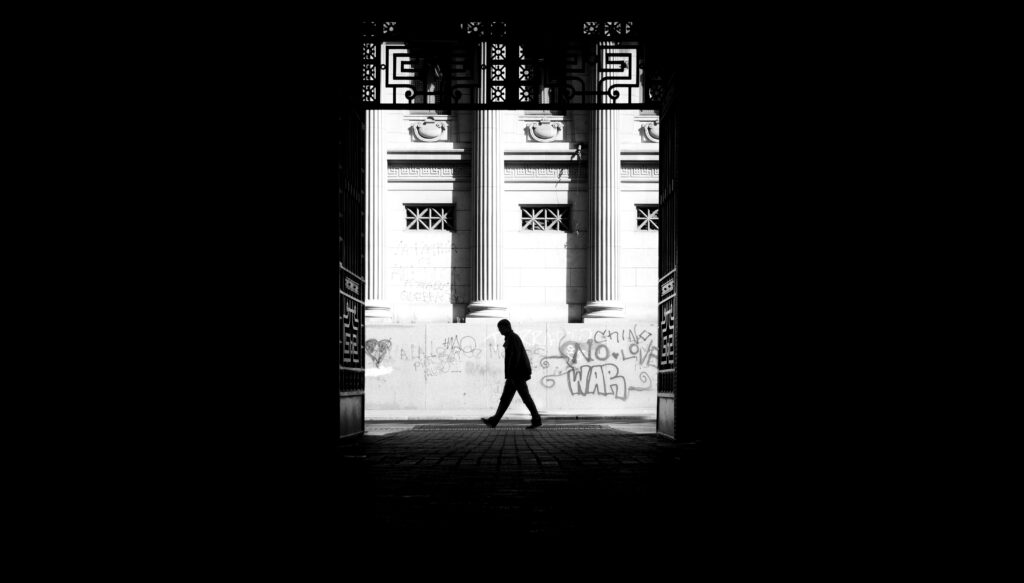
When I came across this image on openverse, I felt it had a deeper meaning that we could all relate to in some way. As I grow older, I have started to realize the uncertainty of the future and this image perfectly illustrates how every day we are all walking towards the unknown. Why? Because the possibility of growth, new beginnings, and everything else that comes with it gives us the courage to continue walking towards it. With the help of the soft guitar, it creates a calm feeling to the tense and scary idea of the future portrayed by the image. The combination of the image with the audio gives us a realistic view of life and how moving forward is a natural part of it, even though we each experience it in different ways. At the end of the day, I guess that means we’re all just figuring it all out one step at a time.
Terms of Use: “Walking Towards the Unknown” by Jonathan Pupo is licensed under CC BY 4.0.