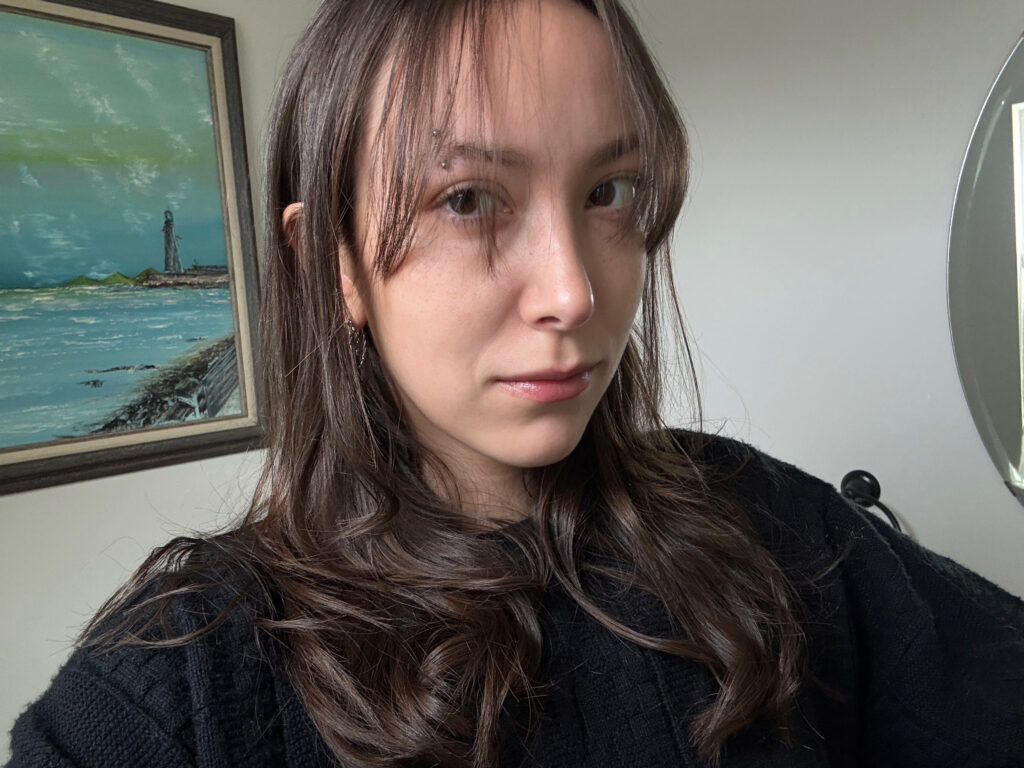
As I join our class blog, I would love to introduce myself to you all. My name is Amal Albaladejo, and I am especially excited for this semester because it is my final one! Upon my graduation this spring, I aspire to begin my career in either museum libraries or archives, with a special interest in art and audio/visual. As of now, I currently work and get all my schoolwork done from the front desk at the Bavarian Inn. It’s located in a tiny, hallmark-esk town called Shepherdstown, West Virginia. It’s super cute, and also near enough to D.C. that I get to venture out to the city from time to time and walk amongst some of the greatest museums.
Along with my interest in the audio/visual, I come from an undergrad of Digital Communications & Multimeda Production through Florida International University. I decided to take this class because I believe it greatly complements MIS coursework as these are hard skills we can use in the field, and I would love to improve those production skills at a graduate level. Though I have learned so much through this program thus far, I have missed those creative assignments and am thrilled to have them back for my final assignments ever (that’s crazy to think about).
Outside of work and school, I love to explore and spend time out in nature, whether that be camping, swimming, or taking my dog on a hike (he may look small, but he’s got it!). Often, I will make video diaries of my travels to upload to my just-for-fun YouTube channel, or at least bring along my camera to snap some photos. When home I like to relax by painting, strumming the guitar, or watching films (and logging them on Letterboxd of course).
I can’t wait to get to know all of my peers, and am looking forward to a fun, final semester! 🙂
My name is Viviana Mendiola, and I live in Miami-Dade County, Florida. Living here has influenced how I think about communication and access to information, particularly in environments where people rely heavily on digital tools and informal networks to get things done.
I am a practicing attorney. My path here was not linear. Before law school, I had to choose between studying law or library science, and I chose law first. At the time, librarianship did not seem like the right fit. With more experience and perspective, I have come to see it as something I want to explore now, especially in relation to digital media and information work. In many ways, librarianship now feels orthogonal to my legal training while still drawing on it in productive ways.
My interest in digital media connects closely to my work as a Pro Bono Director at a local nonprofit, where part of my responsibility involved supporting the recruitment of pro bono attorneys. Although a PR firm managed our social media accounts, I worked closely with them by providing photos, developing ideas for posts, promoting events, and offering feedback on content. I also helped draft a newsletter as part of those outreach efforts. That experience required thinking carefully about audience, messaging, and the epistemic implications of how information is framed and circulated in digital spaces. It was a collaborative process that taught me a great deal about how digital communication works in practice.
I have always enjoyed writing and visual art. I grew up around drawing and painting, and my mother is currently pursuing a master’s degree related to art. I took a drawing class myself, and while I do not consider myself an artist, I am interested in developing my creative side more intentionally. That interest has increasingly taken on a curatorial dimension, particularly in how visual and textual materials are selected, organized, and preserved.
I studied intellectual property law in law school, although long enough ago that much of it warrants a careful revisit. I am interested in approaching those issues again from a digital media and information-science perspective, particularly in the liminal space where creativity, technology, and authorship overlap.
I am also interested in how libraries function as stewards of cultural memory. One example I find especially compelling is the handwritten lyrics to a Beatles song held by the British Library, which treats popular music with the same archival seriousness as canonical literature. I visited London once but did not make it to the British Library, largely because I was too tired to get off the double-decker bus. That remains an unresolved issue and a reason to return.
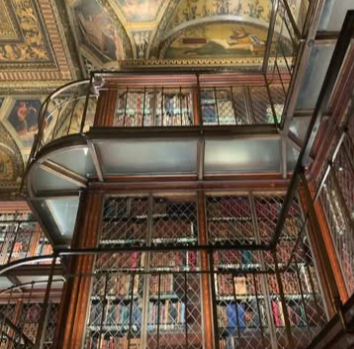
I recently visited The Morgan Library & Museum, and it was a space where architecture, collections, and design reinforced how information can be both rigorous and visually compelling.
I am especially interested in this class because creating a blog is something I have wanted to do for some time. Having it as an assignment provides the structure and push I needed to finally start. I am looking forward to using this space to write, experiment, and think more deliberately about digital media over the course of the semester.
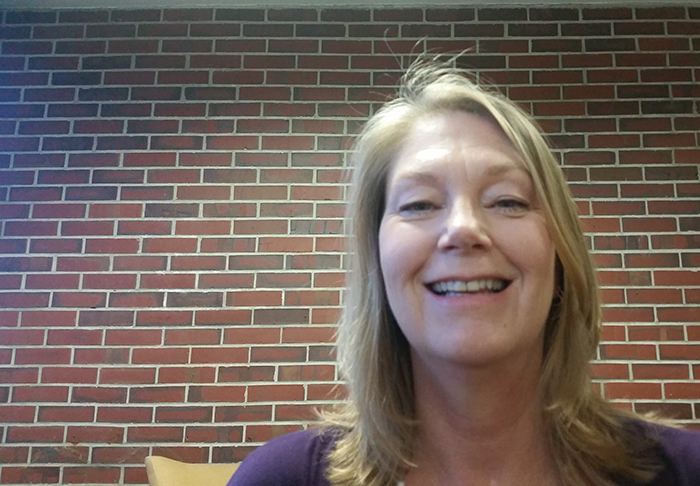
My name is Jane Barrager and I will be your guide this semester on the subject of Digital Media: Concepts and Production.
I am originally from Detroit, but I’ve been living in Florida since 1992, and in Tallahassee in particular since 1996. Like many northerners, I came here for the warmth and Sunshine.
I am a graduate of both the undergraduate and graduate programs at Florida’s iSchool located in the School of Communication and Information and Florida State University. In fact, I am one of the first original 6 undergrads to ever be enrolled at the, previously graduate only college. The funniest story I have of that time is the day that I sat next to Warrick Dunn in class and had no idea who he was. I sat next to him on the first day of class because he looked lonely – it seemed to me that the other students in the class where, for some reason, keeping a wide berth around his seat and, feeling sorry for this poor guy, I sat next to him. During the first class our professor asked us to turn to the person next to us and describe the first thing we were going to buy when we graduated and started making money. I don’t remember what I said, but Warrick started describing what I knew (being a Detroiter and all) to be about a $60K vehicle. My response? “I hope you find a good job when you graduate, because you’re going to need it to afford that!” Warrick just smiled. About the third class period I woke up late for class, pulled on the dirty clothes lying next to my bed, swept my uncombed hair into a pony tail, and ran, make-up-less, to class and sat down next to my new friend (who’s name I still did not know). Suddenly a news crew burst into the room, shoved cameras and microphones into my deskmate’s face and started rapid firing questions at him which he answered with confidence and ease like it was the most natural thing in the world. When it was over I looked at him and said “Who the hell are YOU?” He smiled and said, “my name’s Warrick”, and it was at that point I realized who he was. So, my first taste of learning about multimedia at Florida state was when I was featured on national television as the seat partner of the infamous Warrick Dunn on ESPN’s “Sports Center” – makupless and, I’ll admit it, hungover!
I discovered in college that teaching was my passion. I’ve been teaching since 1998 and, although I spent some time teaching computer literacy at our local community college, the ischool has been my home since then. I’ve taught a variety of courses both online and f2f including: Intro to Information Technology, Social Media Management, Digital Media: Concepts and Production, Design and production of NW multimedia, Perspectives in IT, Electronic Media production, Technologies for Information Professionals, Research Methods, and Web site development to name most. I also spent some time working for the Office of Distance Learning developing web-based learning modules and other websites for the FSU community. In my current position I serve as the ischool’s Instructional Support Specialist which basically means that I help other faculty rehab classes. I also train and supervise doctoral students who teach in the UG program.
Now you all know a little about me, and I look forward to reading your stories as well. See you online!
In Alejandro Gets to Gardening, budding gardener Alejandro runs into a worm while seeding lettuce. A compromise eventually turns into a dance party, and friendship blossoms.
The puppets are both made and shot by me! Creative Commons assets included are in the title and credit screens and Alejandro’s Gardening book, Gardening for Stupid Idiots. My friends recorded the narration for me, and the music a creative commons asset.
Fair Use Disclaimer: “Alejandro Gets to Gardening” claims fair use of Lady Gaga’s “Poker Face” according to Category 6: Quoting in order to recombine elements to make a new work that depends for its meaning on (often unlikely) relationships between the elements
I normalized and spliced together the narration using GarageBand and edited my video using Canva.
Synopsis: “Victory” shares a story of someone realizing the need to overcome their alcohol addiction, what led to the realization, and shares how they were able to turn away from their addiction and how to fight the continual battle each day.
Synopsis: Olivia, a determined toddler, conquers the rock wall, tunnel, and chain ladder at the big kid playground, but freezes at the towering slide. Facing her fear, she must decide whether to return to the little tikes playground or summon the courage to slide down and prove she’s ready for the big kids’ world. With a deep breath and a leap of bravery, Olivia takes the plunge, realizing that sometimes being big and brave starts with one small whoosh!
All original footage/audio shot on an iPhone 14 Pro Max by myself, Mariah Fuertes. Edited on iMovie (mobile/iPad version).
This story will follow both the Brain and Heart showing their perspective of what anxiety is and how it impacts them. Also, showing us how the Brain and Heart conflict with each other.
Content and Creation:
All images were originally drawn in Procreate and combined Adobe Photoshop. For audio related resources and editing software I used TikTok’s text to speech feature, QuickTime Player, and Audacity. Also for video editing I used a combination of Canva and CapCut.
Image Credits:
All Brain and Heart illustrations belong to Katie Kimberly are licensed under CC BY-NC 4.0
Synopsis: This story is about a strange knocking on a bedroom door late at night. The camera investigates and discovers it is best not to answer the door.
I captured the video footage and recorded subtle sound effects, including quiet taps and background voices on my iPhone 16. Video editing was completed using iMovie and Canva, Audacity was used for sound design.
After her brother mysteriously vanishes, Delilah Clarke, a young sound engineer, discovers a hidden frequency that allows her to hear voices from the other side. As she deciphers the messages, she realizes her brother is trapped in an alternate dimension—one created by an experiment gone wrong at the radio station where he worked. With time running out, Delilah must use her unique ability to uncover the truth behind the Ghost Frequency before it consumes her too. Script
Script
(STATIC BUZZ. GLITCHED WHISPER. THEN… SILENCE)
DELILAH (V.O.):
They said he ran away.
They said he quit.
But I know my brother better than that.
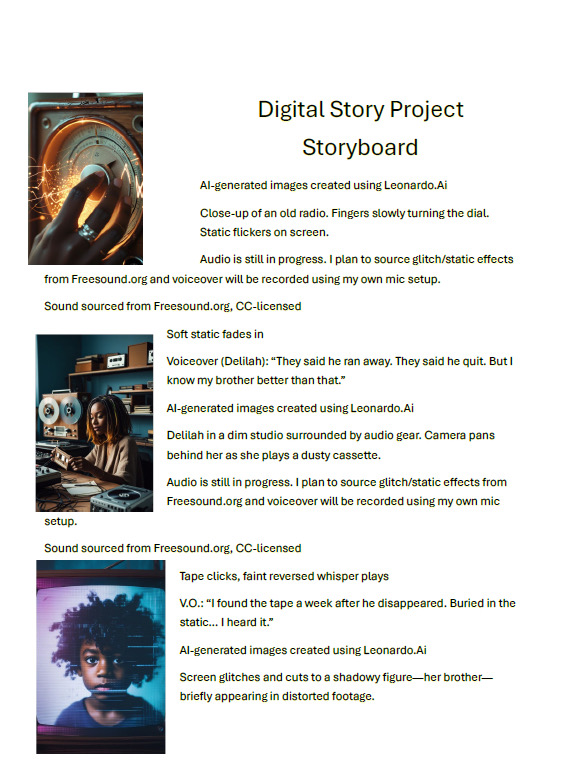
(LOW, DISTORTED FREQUENCY UNDER VOICE. SHOT OF A RADIO DIAL TURNING.)
I found the tape a week after he disappeared.
Buried in the static… I heard it.
(DISTORTED WHISPER: “Help me.”)
They say frequency is just vibration.
But what if sound—can carry souls?
(GLITCH EFFECT. FLASH OF HER BROTHER’S FACE.)
He was working on something.
A sound experiment. Unapproved. Dangerous.
(QUICK CUT: SPINNING REELS, A RADIO ANTENNA FLASHING IN A STORM.)
The deeper I listen,
The more I lose track of what’s real.
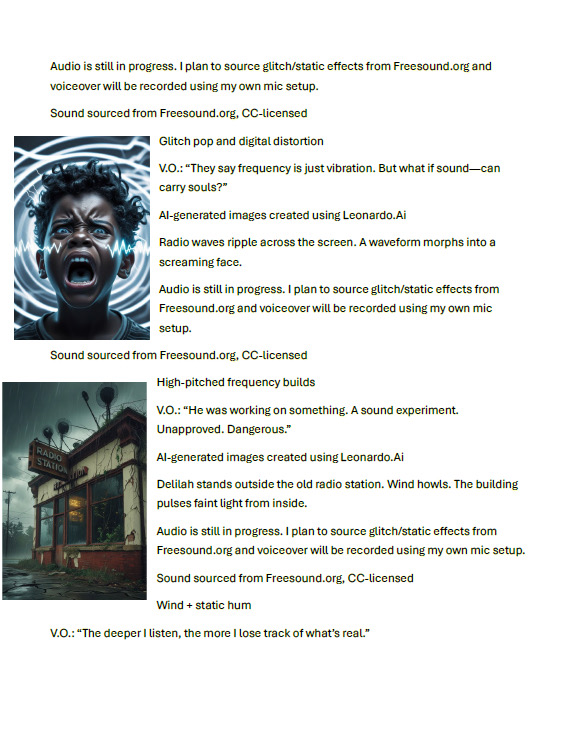
(SCENE: DELILAH STANDING IN FRONT OF AN OLD RADIO STATION. WIND HOWLING.)
But I won’t stop.
I won’t let him fade away.
(STATIC SCREAM. SUDDEN SILENCE.)
Even if it means…
I disappear too.
(SCREEN FLICKERS TO BLACK. LOW HUM RETURNS.)
Media Assets:
Glitch & Static Effects: Radio waves, distorted sound bites, white noise with hidden voices.
Dark & Gritty Cinematic Footage: Abandoned radio stations, dimly lit apartments, strange technological glitches.
Unsettling Visual Transitions: Flickering screens, corrupted video files, and surreal distortions symbolizing Delilah’s descent into maddness.
Voiceover: Narration written and recorded by the author (Chrislene) using personal recording equipment.
Created using Canva for video editing, with video clips and audio sourced from Canva’s internal content library. All assets used under Canva’s Free/Pro Media License. Website: https://www.canva.com
Fair Use: One static image briefly used as narrative illustration; altered, transformed, and justified under the Code of Best Practices for Online Video.
Reflection I – Choosing the Story
When we first started this digital storytelling project, my heart was fully set on creating a story around Yaah Nevah Essien, a Haitian Disney Princess. That concept is incredibly meaningful to me—it’s a long-term dream of mine to bring a Haitian heroine to life in the animated world, where our culture, spirituality, and beauty can be seen and celebrated on a global scale. However, as I began to plan for this class assignment, I realized that executing that vision the way I truly want would require far more time, resources, and world-building than I currently have space for in this course. It’s not a project I want to rush or do halfway, so I made the decision to save that dream for a larger platform in the future.
Instead, I pivoted to “Ghost Frequency,” a supernatural thriller that allowed me to explore my love of psychological storytelling, horror, and sound design. This story still pushed me creatively, especially with building suspense through visuals and audio. I enjoyed playing with glitch effects, eerie audio layers, and creating a haunting atmosphere. It was exciting to step into a darker narrative and build something immersive and cinematic. This process reminded me that while I may have many stories to tell, each one has its own time and this one, for now, was the right fit.
Reflection II – Creating the Story
Creating this video was both a challenge and a creative joy. At first, I intended to use AI-generated images from Leonardo.Ai throughout the entire piece to bring my dark, surreal vision to life. However, I quickly realized that recreating consistent characters and environments in Leonardo was more difficult than I expected. The platform’s variability in visual style made it hard to generate a cohesive story world—especially for a narrative like Ghost Frequency, which relies on visual continuity.
Because of that, I shifted to building the project in Canva and focused on using B-roll footage, overlays, and atmospheric images that still matched the tone I wanted. This decision gave me more control over the pacing, visual clarity, and eerie mood I was going for. One of my favorite parts of this process was layering audio over the visuals—playing with static, whispers, reversed tones, and glitch sound effects to create an immersive and unsettling vibe. It truly felt like I was scoring a mini thriller.
Even my little sister got intrigued while watching me edit—asking questions and getting spooked by some of the whispers! I think for the final version, I’ll add a full voiceover, which will bring even more depth and urgency to Delilah’s story.
Reflection III – The Final Product
I’m proud of the end result—I feel like I was able to visually and emotionally convey the story I had in my head. It surprised me how much I was able to create within Canva, especially combining AI visuals, glitch effects, and layered sound design. If I had more time or advanced tools, I would love to animate actual characters and scenes to bring Delilah’s world to life in a more dynamic way.
Overall, I’ve learned that digital storytelling is truly a process, and it’s rarely perfect. It takes revision, creative problem-solving, and flexibility. But when everything starts to come together—even in a rough cut—it’s incredibly rewarding.