
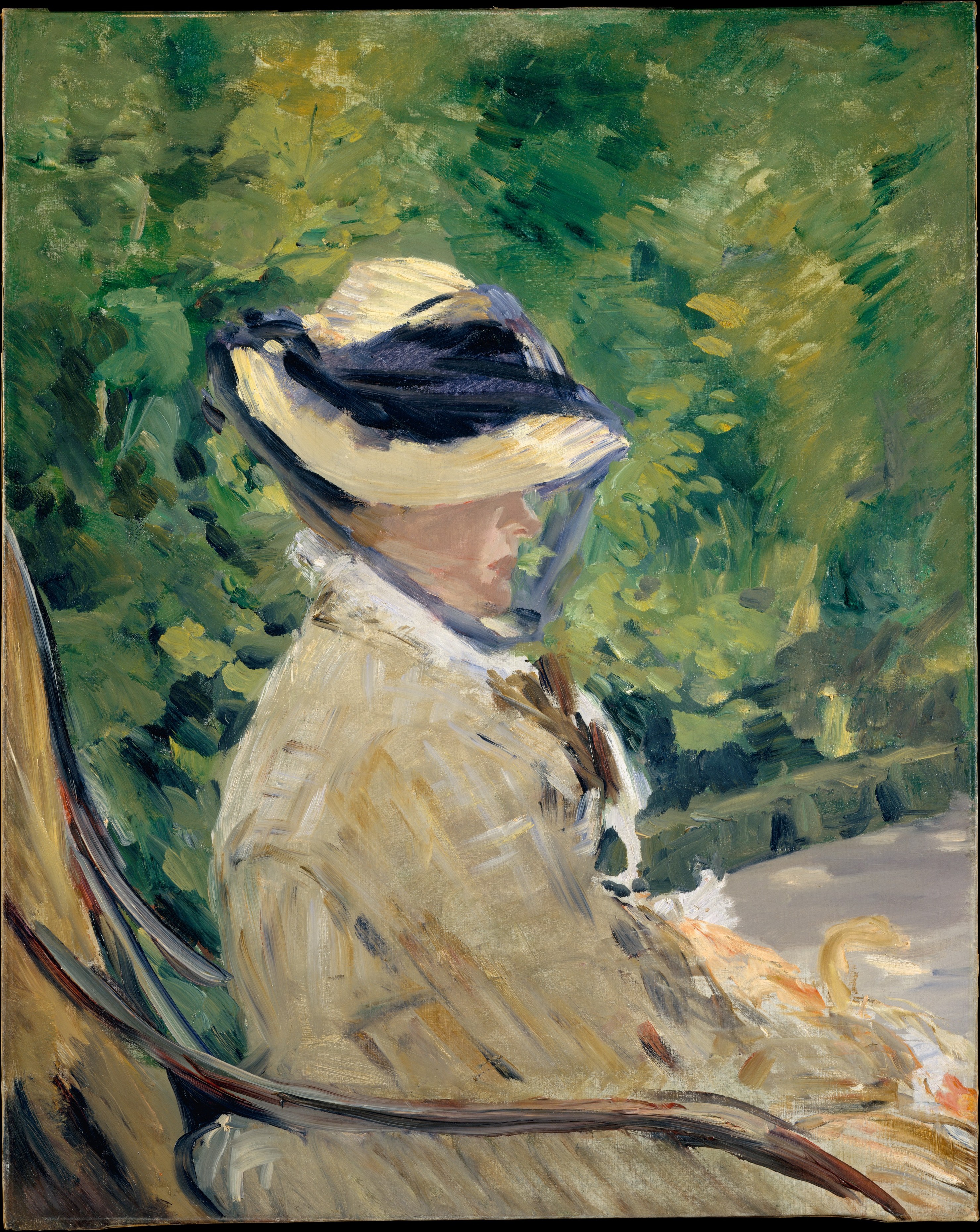
Madame Manet (Suzanne Leenhoff, 1829–1906) at Bellevue, by Édouard Manet, courtesy of the Metropolitan Museum of Art, New York. Public domain (CC0).
April Kisses, by Eddie Lang. Public domain (CC0).
As an art history enthusiast, one cannot help but approach a painting with a heightened sense of curiosity. Who is the sitter, and how does her relationship to the artist shape the image before us? In this painting, the sitter is Suzanne Leenhoff, Édouard Manet’s wife. She sits outdoors, enveloped in lush greenery, her soft yellow dress gently contrasting with the surrounding green. A matching hat dips low, obscuring her eyes and leaving only her nose, mouth, and a hint of hair visible to the viewer. The loose, swift brushstrokes suggest a fleeting, intentional moment, something caught rather than staged. With her gaze hidden, her expression remains a mystery, inviting subtle contemplation from the viewer. Perhaps this is a tender, wistful moment: a husband pausing to capture his wife, suspended in thought, as she looks toward something unseen in the distance.
I chose the audio April Kisses because it echoes the possibility that this painting captures a tender moment of a husband quietly observing his wife. Yet it is difficult to impose a definitive narrative when the artist offers no explicit explanation for the work. As art historians, we often begin with visual analysis, a surface-level reading that allows us to form an initial interpretation before turning to historical context and primary or secondary sources for support. Questions about Manet’s relationship with his wife inevitably arise, but for now, this pairing remains rooted in what the image itself suggests. The scene feels soft and intimate, as though the artist has paused to observe the sitter in a gentle, fleeting moment. For this reason, I selected a piece of music that feels equally sweet and whimsical, reminiscent of a quiet dance shared between two people.

Hi Ana,
I like your post – it’s whimsical, relaxing, and calls back to a time far warmer than right now. I imagine analyzing the art when there is little description of how and why the artist painted it can be simultaneously fun and frustrating for an art historian. One thing I would suggest for future posts is to make sure to have a title – it was a little difficult to click onto your post from the home page of the website (I had to click the “comments” for the post to open this). But I think it’s beautifully written, the music aligns with both the time period and ethos, and it made me want to be out in the park with a cup of coffee and some bird seed.
Hey Anna, this is a great pairing. Manet’s work is always gorgeous, though I must admit that in my art history class, I couldn’t keep my Manets and Monets straight. The music is light and airy, which really helps to capture the scene. I think the low-fidelity audio (the vinyl crackling) really helps bring the pair together. I envision a springtime brunch in the garden. On a side note, you probably overlooked it, but you should give your post a title.
Hello Anna, I truly love your post. Your description of the painting lulled me into a relaxed state as the music played. I have to say, the pairing works perfectly, and having that scratchy vinyl sound that we all recognize brings us back to a simpler time. I envision her simply relaxing in a beautiful garden, watching the birds and butterflies moving freely around while her husband paints her. As others have mentioned, it lacks a title, but your descriptive writing more than makes up for it. I truly felt like I wanted to be sitting there, enjoying that moment.